Saturday, 14 January 2012

Texas Rep. Ron Paul – the Civil War was “Senseless”


While not an avid follower of the GOP presidential race, my attention was drawn to Texas Rep. Ron Paul, who in 2007, declared that the American Civil War was a “senseless bloodbath”. He went on to say that “there were better ways of getting rid of slavery” and it should have been phased out gradually. He points to the British Empire as an example of this. Many historians have disputed the reasons why Britain abolished slavery when it did – some have used economic arguments, declaring the slave trade was part of an archaic system that did not “fit” with the new capitalist age. Others argue anti-slavery was part of a reformist attitude that encompassed a revival in, among others, religion and temperance. But slavery in America cannot be compared so easily to the British Empire – it was part of Southern society, and for many it was a way of life.

What Paul is forgetting here is that hindsight is a dangerous thing – can we speculate whether the Civil War was inevitable? Slavery was an explosive issue, and many politicians seem to forget the “peculiar institution” had ruptured American politics more than once– how many compromises could the country take? How much violence could occur without a Civil War? (Perhaps Paul should research Bleeding Kansas, a bloody war over slavery several years before 1861.) Some form of conflict was inevitable, but it was the men and the circumstances of the 1850’s that made it happen when it did. Paul can decry Lincoln’s decisions as much as he likes, but Lincoln wanted to preserve the Union at all costs. Maybe this made war unavoidable. When discussing this topic, I can never fail to forget the chilling last words of failed insurrectionist John Brown as he was hanged in 1859:

"I, John Brown, am now quite certain that the crimes of this guilty land can never be purged away but with blood."

P.S. Not all soldiers fought for the abolition of slavery - you only have to read James McPherson’s excellent book, For Cause and Comrades: Why Men Fought in the Civil War to understand this. But to call their sacrifice “senseless” smacks of disrespect. Paul is entitled to his opinions on how the war started or whether it was unavoidable, but the 600,000 men who died may take issue with his callous dismissal of their choice to fight.

Monday, 9 January 2012

History and the Benefits of Twitter


As a recent convert to Twitter, I’m just learning the ropes but have already discovered how addictive it can be. I set up an account partly to network among heritage organisations, as well as to spread the message about the RAMA iPhone apps. (And maybe follow a few celebrities in the process, because that is essential for my career). In the past couple of weeks though, I’ve come to realise that Twitter is a fascinating resource – by following organisations such as English Heritage, the National Trust, Past Preservers and a variety of museums, you can get the latest information on upcoming exhibitions, links to history in the news or some great images that have been recently digitised. And they seem very popular – the British Museum (@BritishMuseum) for example has over 75,000 followers, all of whom are free to interact and tweet with the organisation. The History Channel (@HistoryChannel) tweets fascinating facts about what happened on this day, as well as firing off a number of quiz-like questions that their followers can answer. Historian Dan Snow @thehistoryguy) has over 25,000 followers, and frequently tweets interesting history facts covering a wide range of topics. Twitter has made me feel more connected to these heritage organisations, as well to history itself. In these short weeks I seem to have a better understanding of history in the news – articles covering history in education, heritage organisations and recent archaeological finds all make the cut. There are so many different accounts, and I think Twitter is a great example of how history can be brought back to the “people”. I’ve followed several accounts that tweet lines from Civil War soldier’s diaries, a great way to keep the memories of ordinary people alive. Twitter is a fast, effective way of engaging the public – it may be under 140 characters but you can write as many updates as you like. So, I’ll definitely be following more heritage organisations in the future – it’s a great way of feeling “in the loop”. 

Thursday, 5 January 2012

Walk of the Condemned


I’ve just finished writing my fifth tour for the Rama iPhone app, this time on crime and punishment in London. It’s a walking tour with archival photographs showing how places would have looked a hundred years ago. So far I have mostly concentrated on New York, so it was great to research London, where I lived for three years studying at university. This tour takes you along the route where convicts were taken from Newgate Prison to the gallows at Tyburn, near present Marble Arch. The most astonishing part of this history however, is that the prisoners were taken along Oxford Street to Tyburn. ALONG OXFORD STREET. Many people say how history is a “world away” from the present, but this is taking it to a new level. And that’s what makes it exciting. It is almost impossible to imagine the delirious shouts of a blood-thirsty crowd, the sound of hooves and a rattling cart, perhaps the cries or spirited speeches of the prisoners as they were taken to their death…

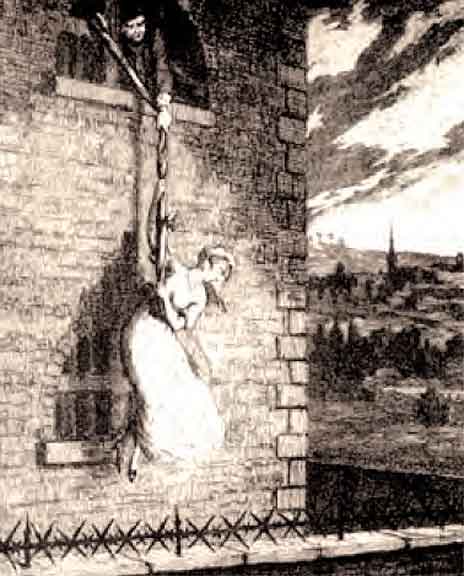
Between 40,000 and 60,000 men and women died at Tyburn – most are nameless, forgotten to history, but some infamous criminals are remembered. The history of prisoner Jack Sheppard is worthy of a Hollywood film. Sheppard was a petty criminal, but he achieved fame through his ingenious ways of escaping prison. Numerous times he used razors hidden in his shoes to make holes in the ceiling or to file away the bars on his cell. On one occasion, imprisoned in Newgate with his partner in crime, Bess, Sheppard made a rope from Bess’s clothing and they descended from the window and into the night. And this happened several times. Once, he even managed to escape when he was chained to the floor. (At this point you can’t help but notice he must have been a poor criminal, since he kept getting caught all the time). The people of London were thrilled to hear of his exploits, since few prisoners escaped from Newgate – he became a hero, and it gave everyone a chance to mock the authorities. But, hubris eventually brought Jack down. One evening after a few drinks, loudly proclaiming his latest ingenious escape, he was arrested for the last time. On 16th November 1724, he was taken to Tyburn, followed by hundreds of people - proving that his execution was one of the most popular ever witnessed. As was customary, he was given one last drink on Oxford Road before he was hanged.

Another famous convict, a highwayman named James MacLaine, was renowned for being a “gentleman” to those he robbed. When he held up the carriage of Horace Walpole, the son of Sir Robert Walpole, MacLaine actually wrote a letter to him afterwards apologising for any distress he may have caused. Things have changed slightly. I doubt anyone is thinking of creating a new museum in this current climate, but how incredible would it be to have one dedicated to this history? Oh, and perhaps a film about Jack.

Check out the Rama app through this link:

http://www.crimsonbamboo.com/

Monday, 2 January 2012

Is the IWM’s Holocaust Exhibition “too traumatic?”


Earlier in the year, I spoke with a university professor about applying for a postgraduate degree. We were talking about art exhibitions, and somehow the conversation moved to the Holocaust Exhibition at the Imperial War Museum. The teacher told me she took her 14-year-old niece to the exhibition, but the girl was so distraught she had to leave. (The age restriction on the exhibition is 14 years and over.) The teacher then stated she thought the exhibition was too traumatic. At the time, I didn’t really think much of this, but after learning about museums in more depth I began to think more about what she had said. Most children study the Holocaust at school – I had to watch parts of Schindler’s List when I was 14, and I remember getting upset about it. But everyone should learn about this dark period in our history, and parts of it cannot be hidden or covered up. Basically, if you take children to the museum, you have to judge whether they will be distressed by it.

The next time I travelled to London, I returned to the exhibition. All of the photographs are very shocking – it is difficult to forget the image of the bulldozer shovelling bodies at Bergen Belsen, or the nameless faces of Jews and gypsies that died in the camps. Among others, the dissection table presents a challenge of interpretation, how do you explain this to children? 

The collection of shoes is a poignant reminder of those who died. It gives us some idea of the sheer number of victims, and shows us the humanity behind an inconceivable statistic. This section can, perhaps more than most, help children understand the magnitude of the Holocaust, as something so simple as shoes gives us something to relate to.

I am glad I returned to the exhibition. It is powerful because of its shocking nature, and as a result it is difficult to forget. Ignoring certain facts because they are “too traumatic” shows an unwillingness to face the truth. A Holocaust exhibition that obscured reality would insult those who died. Hiding the traumatic leads us into a place of comfortable naivety.

Tuesday, 27 December 2011

America’s History Surpasses 400 Years


I am very passionate about American history, but when I try and explain this to family friends or work colleagues, I am usually met by the same response – “what history? They only have 250 years don’t they?” The more I hear it, the more I think about the origins of America and how “old” their country is. If you declare that America only has 250 years of history, you are looking through a very narrow, European lens. If we take this angle, American history began with the Declaration of Independence in 1776. But what were the origins of this? Why did it happen? And perhaps a more practical question, how did people arrive there? The history of one country does not start with a great political event. After all, the colonists did not suddenly appear there in the late eighteenth century. Settlers arrived in Jamestown in 1607, and some travelled to the New World as early as the 1580’s. So, from this angle, a “Western” view of American history stretches back nearly five hundred years. Yet, we must go back even further. The Native Americans have been living on the continent for thousands of years; a trip to any of the Native museums proves this. In the summer, I travelled to Utah and visited the Edge of the Cedars State Park and Museum. The Park contains ruins of an Ancestral Puebloan site, dating from at least AD 825, while human activity in Hovenweep (South-eastern Utah) can be traced to over 10,000 years ago. This prehistory seems to be ignored. To say America has no history, or even ‘culture’, insults the hundreds of Native Americans who live there. We should move away from the idea that history is solely about politics, or even ‘recorded’ history. The concept of “America” as we know it may be relatively new, but the history of native peoples living on the American continent cannot be overlooked.