Friday, 4 October 2013

Deep South Pt 2: "Give me liberty or death". The Road to Slavery, Charleston to Savannah.


[From Tennessee, I drove back into North Carolina to Greensboro. It took roughly four hours, but it is an incredibly important site on the Civil Rights Trail. The drive was worth it.] 

“Friday 29th July – I arrived at the Civil Rights Museum just in time for a guided tour. Before entering the main exhibition, the visitor was greeted by a “Hall of Shame” where photographs of the worst atrocities from the Civil Rights period were displayed. It was designed to point out the hypocrisy of American society: in theory America had always presented itself as a country synonymous with freedom, when the exact opposite was true. There were photographs of violent struggles in Mississippi, the ruins of the church in Birmingham struck by a bomb in 1963, the bodies of Civil Rights activists and the swollen face of Emmett Till. 

In 1955, Emmett Till was visiting family in Mississippi when he allegedly flirted with a white woman. That evening, he was kidnapped, tortured and beaten to death; his body was mutilated and thrown into the Tallahatchie River. He was 14 years old. When Emmett’s body was recovered, his face was so swollen he was almost unrecognizable but his mother insisted on an open casket for his funeral so “the world could see what Jim Crow had done to her son.” The photograph of his body made international headlines. Many African American teenagers had been lynched or tortured before, but rarely had a case involving racist violence and the lack of law and order become so public. The new African American museum in Washington D.C. (opening in 2015) has acquired the original casket in which Emmett’s body was placed.

…The main reason for visiting this museum however was to learn about the Greensboro sit-ins, which revolutionalised the Civil Rights Movement in the 1960s. In department stores, all lunch counters were segregated – a section for white, a section for black. In 1960, four black students named Ezell Blair Jr., David Richmond, Franklin McClain and Joseph McNeil strongly believed in a peaceful form of direct action and were determined to change the laws of segregation. They sat in the white section of the lunch counter in Woolworths and were refused service until the store closed. They returned the next day. A week or so later, their protest had grown to over 20 students from the surrounding colleges, white and black. The sit-in movement spread like wildfire across the South and despite attempts by the white population to remove them (this included pulling students by their hair, spitting at them and shouting vile language in their faces), they refused to give up. After six months of this, the Woolworths store in Greensboro lost over $200,000 and reluctantly the manager desegregated the lunch counter. It would take years for other cities to follow this example, but the news coverage was so extensive the sit-ins became an essential turning point for Civil Rights history.

I wasn’t aware of this at the time, but the museum is situated on the old Woolworths’ building, and has preserved the seats and the lunch counter from 1960. Even the floor tiles were original! It was incredible to stand in the room where four ordinary students made history. Before I left the museum, I had a great chat with the African American security guard (he liked my accent...) He told me some interesting personal stories and his experiences with racism: 20 years ago he left his job because he had scored higher than everyone else in a test but did not receive a raise because he was black. For much of the South, “the Civil War was still being fought”, particularly in Louisiana and Florida where "racial prejudice thrives.”

“Wednesday 31st July – Americans have this image of Britain as a rainy and horrible place. Yes it does rain in Britain a fair amount but not in the same league as the States. For when it rains in America, the heavens open, and rivers form within about three minutes. Unfortunately, I had chosen this particular moment to arrive at Boone Hall Plantation, the first destination I was feeling giddy about visiting. “Have you got an umbrella?” the ticket man asked me as I pulled up at the entrance. (I was wearing a maxi dress and sunglasses at this point and must have looked a prize idiot). “Um, no I don’t. I’m hoping it’s going to stop soon…” My voice trailed away as the man looked at me pitifully. “Enjoy your visit.”

So the infamous drive I had been waiting for, the alley of oaks leading to a spectacular mansion, took place in the pouring rain. Not exactly what I had in mind. After a quick change in the back of my car (classy) I ran to the house and sat on the porch waiting for the rain to stop, which thankfully it did after an hour or so. I booked a house tour and a place on the Gullah presentation, and to kill time I explored the slave cabins. Boone Hall has 9 cabins made out of brick, which is incredibly unusual for the time because most were made out of wood. These cabins were in the front yard and visitors would have seen these first before the main house: if the slave cabins were made from brick, you knew you were entering a wealthy plantation. Each cabin would have housed between 6-12 people, mainly house slaves as the field slaves would have lived in wooden cabins in the fields. (There was a hierarchy among the enslaved, and you were considered ‘higher up’ on the scale if you worked in the house.)

On this particular plantation, long grain rice was grown and produced by the enslaved. This area of South Carolina was famous for rice and cotton, and many plantation owners earned thousands by selling their goods across the country, and beyond. (For example, in Liverpool 90% of imported cotton came from the South.) Depending on the crop and the plantation owner (or overseer if the owner was away on business), the slaves would work from dawn until dusk in the sweltering heat. A slave was seen as property, and often a slave in their 30s with a particular skill (for example, a carpenter) could reach $1800 on the auction block. If a plantation owned 100 slaves…well you do the math. Slaves were allowed one set of clothes per year, and one day off a week (or sometimes once a month, again this varied from plantation to plantation). 

The enslaved were governed by a series of laws called the Black Codes. The laws differed slightly in each Southern state but generally they were fairly similar. Slaves were not allowed to read or write, to answer back or strike a white person. Their testimony was dismissed in court, and they had to carry papers at all times if they were travelling away from their own plantation. They could not travel alone, or assemble in groups (within or outside the plantation). Essentially, the codes were designed to restrict escape attempts and to completely control the slave population.

In each cabin, there was a small exhibition on the life of a slave and what happened to them after the Civil War. Quotes by Frederick Douglass, the fiery abolitionist William Lloyd Garrison and former slave Harriet Tubman adorned the walls. Tubman, my personal heroine, declared “there is either liberty or death, and if I can’t have one, I will have the other.” Standing in those slave cabins was the most surreal moment of my life so far. I had read about slavery for five years, imagined what life must have been like for a slave living in the heart of South Carolina, or in the humidity of Louisiana, but nothing came close to standing in that cabin, feeling the marks of fingerprints on the walls, and looking out of the window to stare at the alley of oak trees. What would the enslaved have experienced within these walls? Loss and sacrifice. Heartbreak and death. Love and defiance. Survival.

It was an incredibly moving experience, and one that I shall never forget.

After a tour of the ‘big house’, I listened to a fascinating presentation on Gullah culture. The Gullah are descendants from African slaves, and the language has influenced society for generations. The Gullah culture focuses on ancestors, and whereas we might say “our guardian angel was looking out for me today” someone who believed in the Gullah way of life would say “my great great grandfather was protecting me today.” In the Gullah culture, no one dies per se: they merely ‘pass on’ to the next life (which is why we say somebody has “passed away.”)

“Friday 2nd August: Charleston – Following on from my presentation yesterday, I went on a Gullah tour of Charleston for two hours, which highlighted many hidden African American sites across the city. A visit to the Charleston Museum was a bit of a waste of time – it was good, but I thought they crammed too much into a small space and didn’t really explain things properly. This is a shame, because the history of Charleston is fascinating, from the pre-revolutionary period to the post-Civil War era. In the c18th, Charles II gave 8 (English) Lord Proprietors the stretch of land in North America that would become known as the Carolinas (this means ‘Charles’ in Latin), and they began building plantations that became an essential part of the economy for many years. After the museum, I booked a ticket on the ferry to Fort Sumter, the place where the American Civil War began. This is one of the world’s most important historical sites, and it was amazing being able to stand there, in a place that saw much bitter fighting between the Unionists and Confederates.”

“Saturday 3rd August – [I went to many historic sites in Charleston on this day, including the Old Exchange Building where I learned a great deal about pirates; the Aiken-Rhett House, a great example of urban slavery and a ghost walking tour. Technically the ghost tour in New Orleans was much better so I will write that one up instead…] The most impressive part of the day without contest was the Old Slave Mart Museum (left). This building was originally a slave auction from the 1850s, and it was incredibly overwhelming to stand in a place where slaves were sold, imagining the cries of the sellers, the traders and the slaves. Soloman Northup, a free black man kidnapped and sold into slavery, provides one of the best descriptions of such a slave market, and declared “it was a mournful scene indeed” as husbands and wives, mothers and children were separated and never reunited. This particular auction was moved inside as Charlestonians believed the slave business “jarred with the genteel aspect of the city.” The museum was small but very good. It was a balanced interpretation of what happened within an auction, from the point of the view of the slave and the trader. It did well to consider slave resistance too: a slave was told to speak little and act obedient, but he or she could tell by trader's questions where they were likely to be sold to. This offered a slave the chance to frame their answers, for example, if a trader asked particular questions about rice or cotton it was likely he or she would remain in South Carolina or Georgia, potentially near family members. If asked about sugar, it would be a ticket to Louisiana. So, if a slave had family on a rice plantation, and he or she was approached by someone in the rice business, they could describe their skill in an effort to be sold to that person. I had never heard of this before and I found it fascinating, if only to add to my interest in how slaves resisted their condition. One particular story reinforced this. One enslaved woman remembered stepping forward on the auction block and realizing she was being scrutinized by a cruel plantation owner named Old Judge Miller. She called out – “Old Judge Miller, don’t you bid for me, because if you do, I will cut my throat from ear to ear rather than work for you.” Miraculously, the Old Judge stepped down, but unfortunately this independence came at a price. The woman’s father had persuaded his owner to buy her, but after witnessing this exchange the owner refused, as he did not want a 'sassy' slave. Heartbroken, the father watched as his daughter was sold to another trader in Missouri.”

“Monday 5th August – I spent the day in Savannah, which if I’m honest was a little bit of a let down. It was a beautiful city but no where near what I imagined it to be and after the beauty of Charleston it seemed rather unexciting. Saying that, I visited Leopold’s ice cream parlour, the 5th best parlour in the world. I had a chocolate, raspberry and vanilla sundae and it’s probably the most beautiful thing I have ever or will ever eat in my life. [All ice cream I have had since has tasted like dirt. Truth.] To maintain my excitement over dinner, I had a trolley tour of the city, which is not something I usually do but it was hot and I was so exhausted from Charleston I wanted to sit down for 2 hours and be driven around. It turned out to be a fabulous tour, with lots of interesting anecdotes:

1.) Mirrors were often placed on the outside of houses to make the house bigger and also so ladies could adjust their skirts before entering (it was considered most shameful to show a petticoat in the c19th).
2.) Pineapples are a symbol of welcome and were placed in the window of a house to indicate a party was going to take place. However, when the pineapple was removed from the window, you knew it was time to leave.
3.) Ladies would carry smelling salts around their necks to aid their friends if they fainted in the heat. (Corsets sound like a nightmare).
4.) The statue of a Confederate Soldier stands in the famous Forsyth Park. This was built by the Daughters of the Confederacy shortly after the Civil War, but it was shipped to the South via water as the women did not want any section of the statue to touch Northern soil. The soldier stands facing North, ready to defend his people once again.

I briefly had a guided tour around the Richards-Owen House, another example of urban slavery within Savannah. It was a lovely house, and was infamous in the c19th for its size, elegance, and modern features. The house had an indoor plumbing system in 1819, fifteen years before the White House! Unfortunately, the life of the slave was once again shunned and ignored. It is interesting and irritating to watch a tour unfold with so little mention over an essential part of social history, and frankly if we’re going to be blunt, economic history."

Saturday, 28 September 2013

Deep South Pt 1: From Cotton to Creation Stories. The Journey from Charlotte to Cherokee

[Since I returned from the Deep South, I've been typing up sections of my travel blog that cover the interesting, the weird, and well, the weirdly interesting. In five and a half weeks, I drove 4,100 miles through seven states, visiting mountains, beaches, and a grand total of 76 historic sites. It would take months to write about each event in detail, so here follows the toned down version of the most incredible trip of a lifetime.]

"Wednesday 24th July - After an early morning car journey, two flights and two wasted hours watching the so bad-it's-good Hansel and Gretel, I have arrived safely in Charlotte, North Carolina! Blinking in the late afternoon sunshine (and HUMIDITY) I hailed a cab to take me to my unsurprisingly grotty motel. Taking a taxi in the States can go two ways: one, the silent ride to your destination, or more often than not, a chatty rant about the state of American politics and society. Typical taxi talk. Luckily, this time it was the latter. That's not sarcasm either, I think you can only get to know a country by talking to the locals - whether it be taxi drivers, cafe owners, waiters etc - only then can you build a picture of what America is truly like, not what we imagine it to be. The cabbie had emigrated here sixteen years ago from Nigeria and only remained here because of his daughter (he had a small picture of her in the car visor). For working men like him, 'the rich keep on taking, and the poor keep getting poorer.' He talked a lot about the Tea Party, and how they stood for the rich, middle class - and white. He talked of the racial struggles and how most Americans were not ready for a black President, especially places like 'culturally backward' Mississippi. After he dropped me at the hotel, we shook hands and I thanked him for the interesting conversation. He laughed and said with a smile, that some people in the States would raise eyebrows at a black man talking informally to a white woman. I haven't been in the South for AN HOUR and already I'm hearing the rumblings of racial conflict. I had been expecting this, but what struck me most about him was his concept of America. In his words, he said "America has the blueprint to change the world" and if she doesn't stand and grab it, she will fall. Despite all the social and racial problems (and let's face it, these are problems that are not specific to America) his view of what America stands for remained unchanged. Here was a man who was not native to the US, but had been touched, infected, absorbed-by-osmosis the philosophy that in theory, America has the ability to stand as an ideal and perfect nation. She only has to live up to these ideas in practice. It's a historical concept that is deeply embedded in society. In the c17th John Winthrop wrote of the new nation as a "city upon a hill", a superior nation others should look to. A century later, Crevecoeur stated "here individuals of all nations are melted into a new race of men, whose labours and posterity will one day cause great changes in the world." This attitude always fascinated me at uni, and it's incredible seeing it in practice. That America has designed herself as a unique nation, a grand experiment, which if successful, can change the entire world. Of course, America's history is littered with failures and compromises over the contradiction between this blueprint and reality."

"Thursday 25th July - First day in Charlotte and I headed to the Levine Museum of the New South, pretty much the main reason why I wanted to go to the city in the first place. It was a brilliant museum, modern and interactive, and it considered how the South survived after the devastation of the Civil War. In the antebellum period, (before the war) "COTTON WAS KING" but industrialists had to find new ways of manufacturing cotton since slavery had been abolished. For the poor white or black farmer however, it meant a harsh existence, living in poverty across the Carolinas. Former black slaves worked as tenant farmers, often in the plantations they had been sold to. Some moved North to start a new life, but many remained behind - with no money, where were they to go? If friends and family remained, why venture North to an unfamiliar land, where, despite what we may now think, the North was also a hotbed of racism? At the end of the museum, a visitor experience panel asked people to comment on certain moral questions. One asked - "Do you think the South has equality now?" Interestingly, most responses were in the negative, although some acknowledged the South was slowly working towards it..." 


Friday 26th July - [This was the day I picked up my glorious car, the beautiful and smooth Hyundai I named 'Serenity'. People might not get the nerdy joke there.] "From Charlotte, I made my way to Cherokee, on the border between North Carolina and Tennessee, and literally, at the foot of the Great Smokey Mountains. I stopped at the Cherokee Indian Museum, another excellent museum that chronicled the history of the Cherokee nation. The first exhibition concerned creation stories, and how the Cherokee believe the Earth was formed: the water beetle swam down through the ocean until he found some mud and carried it to the surface, and this became the Earth. The water spider first gave men fire, after unsuccessful attempts by many of the other animals. The owl tried to take a branch from the fire but her eyes became so thick with soot she rubbed them until she had white circles around her eyes. The raven failed too, but not before her wings were dyed black from the smoke. The importance of plants in Cherokee society was explained in another creation story: after men had killed many creatures of the Earth, the animals held a council and said that every animal killed would mean another disease released amongst men. In response, the plants held a council of their own and decided that for every disease a plant would offer a cure...The rest of the museum focused on the Cherokee in the eighteenth and nineteenth centuries, and how the French, British and Americans used them firstly as pawns in their wars and then drove them off their native lands. Along with the Creek, Chocktaw and Chicasaw tribes, the Cherokee were forcibly marched to Oklahoma in the 1830s. Thousands died of disease and starvation on this infamous Trail of Tears, or translated from the Cherokee, 'The Trail where we cried". There was even a fascinating exhibit on the Cherokee in London, when several chiefs visited Britain and were paraded in front of royalty and upper class society. I also learned of Sequoyah, an exceptionally smart and hard working man, who spent 20 years creating the first written Cherokee alphabet in the 1820s - it took twice as long as his long-suffering wife burned his first copy. OUCH. Incidentally, the Cherokee do not have a word for goodbye, instead they say "Until We Meet Again..."

"...I also visited the Cherokee Indian village, where members of the tribe display the crafts, pottery and weapons their ancestors would have used. It's a great way of showing visitors how these things would have been made, as well as showing their enormous talent. The Cherokee tribe is split into seven clans - the Wild Potato, Bird, Long Hair (the original name is now lost), Painted, Wolf, and Deer. Each clan brings something unique and/or traditional to the tribe, for example the role of the Wild Potato clan is mainly agricultural, so to gather food or plants; while the Bird clan collected eagle feathers, a sacred object to the tribe (so much so that during the Eagle Dance the feathers decorating the dancers were not allowed to touch the floor, otherwise bad luck or even death would come to that person or his family). Women were especially important, and some were lucky enough to have the title of a 'Beloved' woman bestowed upon them. In this case, her opinion would be held in high regard, and she would be consulted in times of war and peace. The women in the tribe could also decide the fate of Prisoners of War, be it assimilation, torture or death; and if she wanted a divorce, the man would not be consulted: he would return home to his tipi and find his things outside. Awesome." 

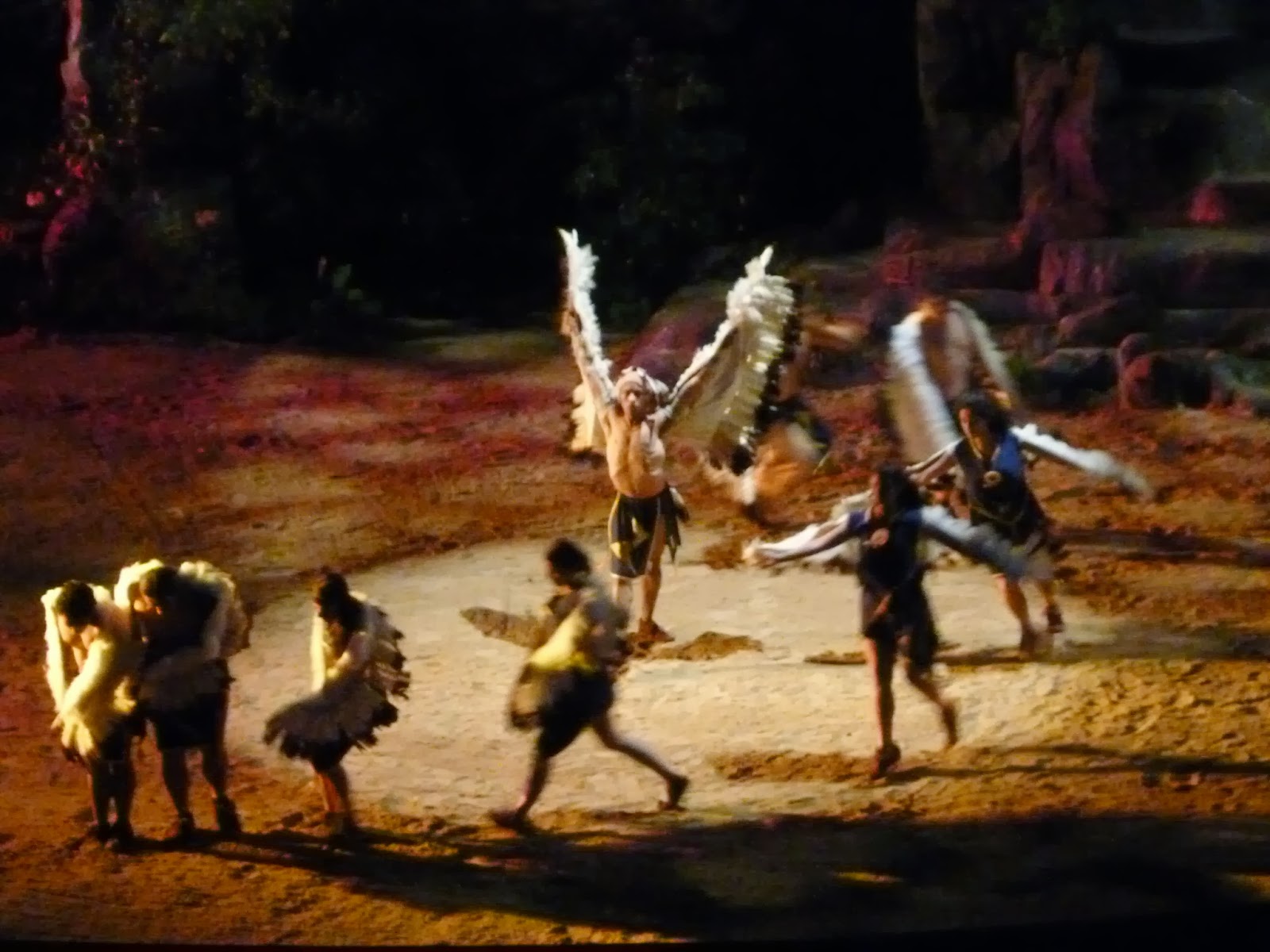
Saturday 27th July - [After driving back and forth through the stunningly beautiful Great Smoky Mountains, I found myself again in Cherokee on Saturday evening for "Unto these Hills", a Cherokee drama that has been performed since the 1950s, chronicling an important moment in the tribe's history.] "The story centred on Tsali, a Cherokee who killed two American soldiers in an attempt to escape the occupation of his lands. Him and his family went on the run, and the remaining Cherokee were told that if they helped hunt down Tsali, they could keep their lands. They agreed and Tsali sacrificed his life, and that of his sons, to protect his people. The Cherokee in Eastern Tennessee are direct descendents from this band who were not marched south. In every single Native American museum I have been to, no matter how horrific the stories that emerge over the generations, from death to cultural genocide, the story remains one of survival. Many languages have been lost, but many survive, and are being passed down to younger generations. I once heard the quote "the best form of revenge is survival." This holds true..."

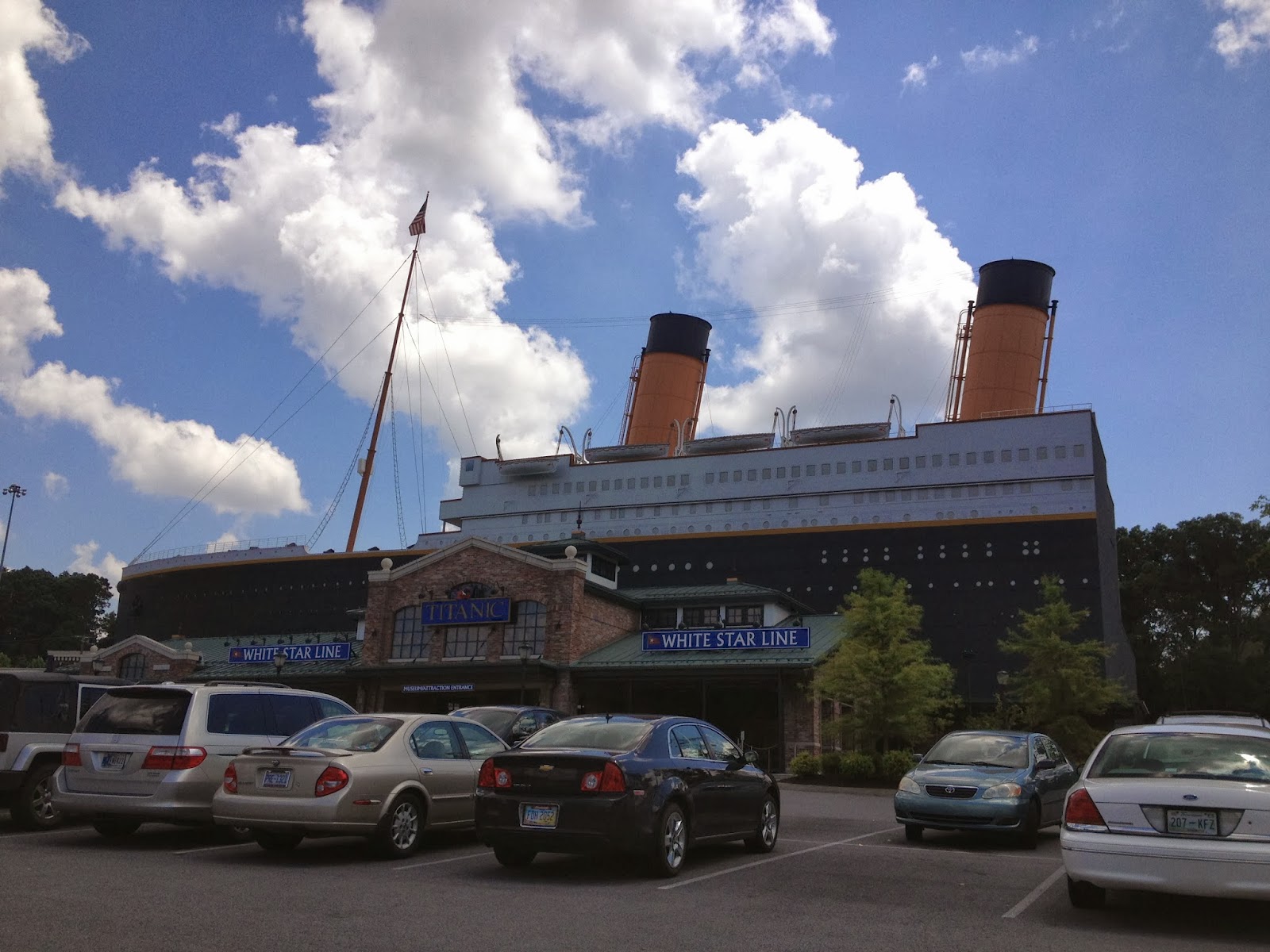
Sunday 28th July - [From the culturally interesting, to the culturally weird. Looking back on what I've written, it still doesn't explain the level of crazy I saw here.] I drove to Pigeon Forge, a small dot on the map in the middle of the mountains of Tennessee. What did I expect? Nothing much. After all, I had come here to visit the Titanic Museum. Since I'm from Southampton, and I worked in a Titanic Museum for a year, I thought it would be a good place to go. But in all seriousness, Pigeon Forge is the WEIRDEST PLACE I HAVE EVER SEEN. EVER.  It’s like a giant funfair, an arcade, a commercialised mess, but somehow it's HORRIFICALLY HYPNOTIC. A long road of about five miles contains such delights as a large wax museum with King Kong climbing up a replica of the Empire State, themed dinner shows about Hatfield and McCoy, or Feuding Lumberjacks, a huge Christmas village, a ski chalet, an upturned White House...It’s so difficult to describe because it’s all so new and looks absolutely crazy. God I wish I could describe it better. Literally right next to the Smokies you have the most commercial town I’ve ever seen. After all this, I thought stupidly I wouldn’t spot the Titanic museum amongst the huge buildings and the lights, but I clearly hadn’t got into the spirit of things: of course, there was a huge replica of the ACTUAL SHIP. I should have realised that no expense would be spared and naturally they would have Celion Dion playing in the car park next to a humungous iceberg. I got there about 3.30pm (this was a Sunday) and found out later it opened until midnight, perhaps confirming my suspicion it was more of an attraction than a straight-laced museum. But maybe this was because of the town itself. I queued for my ticket and was met with stewards and stewardesses, all surrounded by posters of the Titanic screaming "SOUTHAMPTON TO NEW YORK, APRIL 1912." Upon entry, I was greeted by a man dressed as Captain Smith (with uncanny resemblance to the man himself) and was welcomed aboard. So what did the museum have? What didn’t it have I think should be the question. The artefacts they showcased are A DREAM. Thousands of letters, postcards, menus - even a deckchair from the ship (valued at $100,000), objects a tiny museum in Southampton could never EVER afford. (How does a museum in small-town Pigeon Forge with no discernible connection get all this stuff, over a small museum in the place where the ship actually sailed? Simple answer: money and interest. Americans love the Titanic and everything about it.) They even managed to get Wallace Hartley's violin - this had only been found several months ago in England, and I guarantee Southampton will never see it, but here it was, presented beautifully in the heart of a replica Titanic. Hartley was part of the infamous 'Band that Played On' as the ship sank. It truly is a magnificent artefact.

And the weirdest thing? There was a replica of the facade of the Grapes pub in Southampton, a place that has been long associated with the Titanic and a favourite drinking haunt of much of the crew before the ship sailed. For of course, 75% of the crew were from Southampton, so the disaster had a huge impact on the city. A strange piece of home in the middle of nowhere.

Turning the next corner, they had an exhibit on life during the voyage, the crew and the moment disaster struck. There was a replica of a first class suite belonging to the Strauss family, the owners of Macys. Thinking of Isidor and Ida Strauss always reduces me to tears: Isidor tried to get his wife to go on a lifeboat but she refused, saying "where you go, I go." Before the ship sank, they were glimpsed sitting in deck chairs, holding hands. (The scene from the movie Titanic where the old couple hold each other in bed is based on their story). In the 'disaster room' you could touch a real iceberg and plunge your hand in water (at 28 degrees) where hundreds of people perished. Typically, you could survive 6 minutes in that temperature; my hand began to burn after a few seconds. Horrible. 

Perhaps the most impressive thing though, was an exact replica, size and scale, of the Grand Staircase. It's not often I'm rendered speechless over something but after everything I've read, even watching it on James Cameron's film, standing at the bottom of the staircase looking up at that glass dome was unreal. It was easy to imagine the life of the rich, the elegance and sheer luxury the Titanic offered. 

The scale was incredible, but I think the jury is still out though. I just have a nagging feeling about it. Maybe because the museum is in the middle of a fun fair, or perhaps it's too commercialised for my taste...regardless, it was an awesome experience."


Friday, 27 September 2013

An Enslaved Woman's narrative - the mystery may be solved

In the last few days of my Southern trip I bought an edited version of 'A Bondwoman's Narrative', said to be the only novel written by an enslaved person. Professor Henry Louis Gates, the most famous historian of African American history and literature, purchased the manuscript for $8,500 in 2001 and published an edited version the following year. The author used a nom de plum (Hannah Crafts). Funnily enough, I came across the article below the other day, in which a historian claims he has discovered her identity. HUGE NEWS!!

Hannah Bowen was enslaved on a North Carolina plantation, owned by a man named John Hill Wheeler. In 1857, she escaped dressed as a man, much in the style of Ellen Craft, and settled in New York where she became a school teacher. Her novel is semi-autobiographical, and focuses on life on a plantation and eventual escape. Interestingly, her novel borrows from nineteenth century stories at the time, notably 'Jane Eyre' and 'Bleak House'. But this raises a question: how was a slave able to write such a book, when it was illegal to teach a slave to read and write? Historian Gregg Hecimovich claims to have some idea. He believes Bowen would have known 'Bleak House' well for example, as a nearby girls school were required to learn passages from memory. Bowen could have listened to students reciting it, or may have stolen a copy.

BEST PIECE OF NEWS I HAVE HEARD ALL DAY

http://www.nytimes.com/2013/09/19/books/professor-says-he-has-solved-a-mystery-over-a-slaves-novel.html?hp&_r=0

Sunday, 22 September 2013

Washington Gallery of Art Honours Black Soldiers

The National Gallery of Art in Washington is celebrating black heritage with a series of portraits depicting the role of the 54th Massachusetts Regiment during the Civil War. The exhibition, 'Tell it with Pride' focuses on the memorial to Colonel Robert Gould Shaw, who led the regiment, and the black soldiers who served under his command. The first Congressional Medal of Honor to be given to an African American soldier (after the Fort Wagner battle) will be on display, as well as the portraits of Frederick Douglass and Harriet Tubman, two of the most famous fugitive slaves. Before the 54th Massachusetts, many in the North remained skeptical of the regiment but their heroic charge at Fort Wagner changed the prevailing opinion. It was this infamous charge that was featured in the film 'Glory'; what the film doesn't show is that a third of those who were present at the battle were killed, wounded or listed as missing. Shaw's family received an anonymous letter detailing the bravery of the 54th, and encouraged them to "tell it with pride to the world."

http://www.washingtonpost.com/local/national-gallery-of-art-explores-history-of-1st-black-union-soldiers-from-civil-war-in-photos/2013/09/15/a97cf85c-1e1d-11e3-9ad0-96244100e647_story.html

Monday, 16 September 2013

Great War Centenary Project


 In 2014, the world will commemorate the one hundred year anniversary of the First World War. A website, http://www.1914.org/wall/ has been set up to draw attention to this, and the Imperial War Museum is planning to build an interactive wall - via email, twitter or facebook, you can ‘light a light’ on this wall by signing your name and remembering those who fought.

I strongly urge everyone to do this – the sacrifice made by 16 million people should never be forgotten, and the centenary presents us with a unique opportunity to remember. Spread the word!

The History of the Empire State Building


“Like little spiders they toiled, spinning a fabric of steel against the sky” (The New Yorker) In the late 1920’s, John Jakob Raskob, former vice president of General Motors, wanted to build his own skyscraper and compete in the race for the tallest building. He bought the land where the Waldorf=Astoria stood for $16 million and hired architectural company Shreve, Lamb and Harmon to design it. Raskob reportedly asked William Lamb, “Bill, how high can you make it so it won’t fall down?” The construction demonstrated the height of efficiency - builders worked in fours, making the rivets and placing them on the steel frames over a thousand feet in the air. A railway was built to transport materials back and forth and bricks were laid down on an express line which was stored underground. Every week, roughly four stories were completed – the use of steel and pre-assembled materials aided the fast construction of the building. It took three thousand men one year and 45 days to build, and official records state that five workers died. On average, over 2,400 tons of steel was put in place every week, an astonishing feat that resulted in the building being finished one month early. Richmond Shreve described the construction as “a parade in which each marcher kept pace and the parade marched out of the top of the building, still in perfect step”. In May 1931, the Empire State was officially opened by President Herbert Hoover lighting the building from Washington D.C. (although someone flicked a switch in New York, lessening the romantic image somewhat.) 

There are thousands of stories that surround this iconic building, but two in particular stand out. In July 1945, Lt. Colonel William Smith was flying a U.S. Army B-25 Bomber through New York, planning to land in Newark. The weather was poor, and as Smith dropped lower to gain better visibility, he collided with the Empire State. The plane smashed into the 79th floor, causing a hole 20ft high and creating fires down to the 75th floor. Fourteen people died, and one survivor described how “three quarters of [one] office was consumed in this sheet of flame”. Part of the engine hit an elevator, and the two women inside were only rescued because the emergency elevator procedure kicked in. The crash caused $1 million in damages, nearly $11 million today. 


Two years later, a famous photograph would make headlines. Evelyn McHale jumped from the 86th floor of the Empire State to her death. A handwritten note declared to her fiancĂ© "I wouldn't make a good wife for anybody." Robert Wiles took a picture of her body a few minutes later, and it became known as the “the most beautiful suicide”. (http://0.tqn.com/d/manhattan/1/0/U/s/evelyn-mchale-beautiful-suicide-empire-state-building.jpg)


Saturday, 14 September 2013

Early review for '12 Years a Slave'

Advanced reviews for '12 Years A Slave' have filtered through the Internet, and apparently, the film is a must see. This review from Digital Spy gave it 5 stars - http://www.digitalspy.co.uk/movies/review/a513689/12-years-a-slave-review-ejiofor-shines-in-brutal-slave-narrative.html

This film is going to be a huge moment in American history. For the first time, a motion picture will depict slavery in its brutal form - whipping, rape, lynching, slave auctions - the daily life of a slave.

The story is based on Soloman Northup, a free black man who was kidnapped and sold into slavery for 12 years. Not a unique occurrence, and one that - thankfully - is getting all the attention it deserves.

There will be critics - those that argue too much focus has been placed on the hardships of African Americans. But the history of slavery has been covered up: from the hushed or non existent conversations in historic houses to the poverty African Americans experience as a direct result of slavery. '12 Years a Slave' will be incredible and terrifying at the same time.

No book or film can depict the true extent of slavery. Nothing can depict the agony of torture, rape, murder, the separation of family - but any film that dares to try should be praised for its courage.

Thursday, 12 September 2013

US Trip 2013

Wow. It is very hard to describe how perfectly wonderful my Deep South trip was. A cultural and historical journey of over four thousand miles, through seven states, in just under six weeks. To say I learned a lot would be a huge understatement. When I get a chance I will be write up some of the fascinating stories I came across, and 'review' (in a non-pretentious way!) some of the museums and plantations I visited. It was an expensive ride, but LORD was it worth it.

Sunday, 21 July 2013

Horrible Histories

I just wanted to say how much I've been enjoying the Horrible Histories series! It's absolutely incredible. I used to read the books by Terry Deary when I was a child - the Rotten Romans, the Terrible Tudors etc - but it's only been in the last few years it has been successfully adapted to the small screen. I've been watching the latest series and I'm hooked, mainly because I learn so much in each episode. In half an hour, kids can learn about the Roman emperors, the Cold War, Brunel or Oliver Cromwell. Last week in ten short minutes, I learned that Queen Victoria was afraid of bishops and pirates in the c18th used to race captured monks on their ships. 

I listened to an interview with the historical researchers on the show - yes, they look for the obscure, the amusing, the violence ,but they also highlight some of the lesser known figures from history and turn this into an amusing and educational sketch. This morning, I watched a skit about Mary Anning, a woman from Dorset who collected fossils in the early nineteenth century. She made several discoveries but was unfortunately barred from the Geological Society of London because of her gender. In 2010, she was recognised as one of the top ten female pioneers of science. A fascinating woman, and I learned this from a kids programme. The great thing about Horrible Histories is that it appeals to people of all ages, anyone can learn something from it and I will continue to champion it even after it's forced off the air!